
Deep Decay:
A cavity that has been left untreated and has penetrated through the enamel and dentin into the pulp chamber.
Hearing the words “root canal” can cause anxiety for many patients, but the truth is that modern root canal therapy is a highly advanced, routine procedure designed to relieve pain, not cause it.
At Bright Whites Dental in Franconia, Alexandria, VA, we perform gentle, precise root canal therapy (also known as endodontic treatment) to save teeth that have become severely infected or inflamed deep within the dental pulp. When a tooth is infected, ignoring it will only lead to worsening pain, the spread of infection, and eventually, the loss of the tooth. Our goal is to eliminate the infection, stop your pain, and preserve your natural tooth for years to come.
Beneath the hard outer layers of your tooth (the enamel and dentin) lies a soft tissue known as the pulp. The pulp contains blood vessels, nerves, and connective tissue. When this pulp becomes infected or inflamed, pulp therapy is required to save the tooth.
Common causes of pulp infection or inflammation include:
A cavity that has been left untreated and has penetrated through the enamel and dentin into the pulp chamber.
Multiple fillings or restorations on the same tooth can stress and inflame the pulp over time.
A fracture in the tooth can allow bacteria to enter the pulp chamber.
A physical blow to the tooth can damage the pulp, even if there are no visible cracks or chips on the outside.
Signs You May Need a Root Canal:
Our dental team utilizes the latest endodontic technology to ensure your root canal procedure is efficient, successful, and completely comfortable.
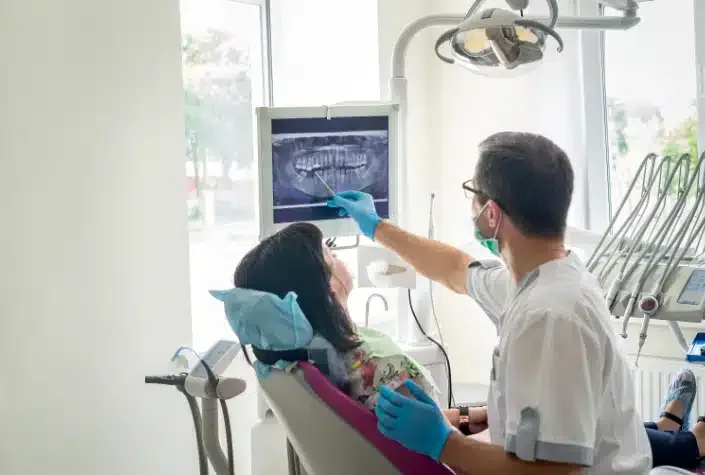
We begin by taking digital X-rays to confirm the extent of the infection. We then apply a strong local anesthetic to completely numb the tooth and the surrounding area. You will not feel any pain during the procedure.
Once you are numb, we place a small protective sheet called a dental dam around the tooth to keep it clean and dry. The dentist then makes a small opening in the crown of the tooth to access the infected pulp chamber.
Using specialized, microscopic endodontic instruments and antibacterial cleaning agents, we carefully remove the infected or inflamed pulp tissue. We then clean, shape, and disinfect the hollow root canals to ensure no bacteria remain.
After the canals are thoroughly cleaned and dried, they are filled and sealed with a biocompatible, rubber-like material called gutta-percha. This prevents bacteria from re-entering the tooth.
Finally, the access opening is closed with a temporary or permanent filling. Because a tooth that has undergone a root canal becomes brittle, we almost always recommend placing a custom dental crown over the tooth shortly after the procedure to protect it and restore its full strength and function.
This is the most common misconception. With modern local anesthetics and advanced techniques, a root canal is typically no more uncomfortable than getting a standard dental filling. The procedure actually removes the infected nerve tissue that is causing your severe toothache, providing immediate relief.
Depending on the tooth (front teeth have fewer canals than back molars) and the complexity of the infection, a root canal usually takes between 60 to 90 minutes. It can often be completed in a single visit, though severe infections may require two visits.
If an infected tooth is left untreated, the infection will not go away on its own. The bacteria will travel down the root canals and into the surrounding jawbone, causing a painful dental abscess. Eventually, the bone supporting the tooth will be destroyed, and the tooth will have to be extracted. The infection can also spread to other parts of your body, posing a serious health risk.
Saving your natural tooth is always the preferred option. Extracting a tooth leaves a gap that can cause surrounding teeth to shift, leading to bite problems and bone loss. Replacing an extracted tooth with a dental implant or bridge is also significantly more expensive and time-consuming than a root canal and crown.
It is normal to experience some mild tenderness or sensitivity in the area for a few days after the procedure, especially when chewing. This is due to tissue inflammation surrounding the tooth. This discomfort can usually be managed easily with over-the-counter pain relievers like ibuprofen or acetaminophen.
Root canal therapy has a very high success rate, often exceeding 95%. With proper care, a tooth that has had a root canal and is protected by a crown can last a lifetime.